account_balance The Gorkha Campaign at a Glance
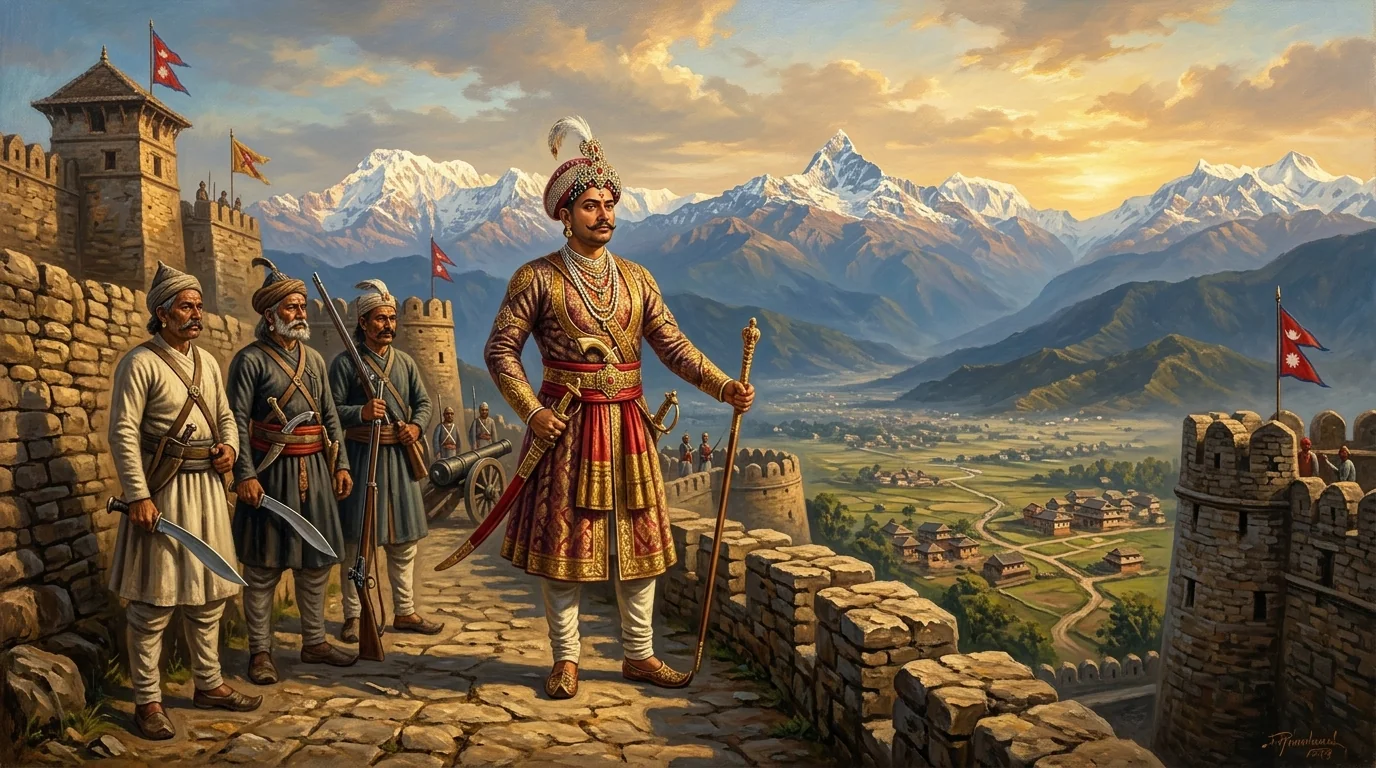
The unification of Nepal is one of the most pivotal chapters in South Asian Himalayan history. Initiated from the fortified hill kingdom of Gorkha in 1743 CE by King Prithvi Narayan Shah, the campaign replaced a patchwork of competing city-states and hill principalities with a centralized Himalayan state centered in Kathmandu by 1769 CE.
The unification of Nepal is one of the most important chapters in the country's history. Before the rise of Prithvi Narayan Shah, the territory that makes up modern Nepal was divided among many independent kingdoms and principalities. The Kathmandu Valley was ruled by the Malla kingdoms of Kantipur, Patan, and Bhaktapur, while the hills and surrounding regions were controlled by numerous smaller states.
From the small hill kingdom of Gorkha, Prithvi Narayan Shah began a campaign that would change the political map of the region. His military victories, diplomatic alliances, strategic planning, and control of important trade routes helped Gorkha gain influence and eventually capture the Kathmandu Valley.
By 1769, Prithvi Narayan Shah had defeated the three major Malla kingdoms of the Kathmandu Valley and moved his capital from Gorkha to Kathmandu. His campaign laid the foundation for the modern Nepali state, although the process of territorial expansion and consolidation continued under his successors.
The story of Nepal's unification is therefore not only the story of one king or a series of battles. It is also the story of diplomacy, geography, trade, regional politics, military organization, and the gradual rise of Gorkha as the center of a new state.
Nepal Before the Unification Campaign
Before the unification of Nepal, the region was politically fragmented.
The Kathmandu Valley had once been united under the Malla dynasty, but after the death of Yaksha Malla, political power became divided among three major kingdoms:
- Kantipur, centered in Kathmandu
- Lalitpur, also known as Patan
- Bhaktapur, known for its eastern agricultural and cultural prominence
Outside the Kathmandu Valley, there were many other kingdoms and principalities. The Baise (22) and Chaubise (24) states in western and central Nepal were among the most important groups of hill states. In eastern Nepal, different rulers and political systems controlled various Kirat territories.
This political situation created both challenges and opportunities. Some kingdoms were larger and wealthier than Gorkha. The Kathmandu Valley, in particular, was economically important because of its agricultural resources, urban centers, trade networks, and connections with Tibet and India.
Gorkha itself was a relatively small kingdom. However, it was located in a strategically important region and had gradually developed its political and military strength. The fragmented political environment allowed ambitious rulers to form alliances, compete for territory, and take advantage of conflicts between neighboring states.
This was the world into which Prithvi Narayan Shah became the king of Gorkha.
Who Was Prithvi Narayan Shah?
Prithvi Narayan Shah was the king of Gorkha and the leader most closely associated with the early campaign to unify the territories that formed the foundation of modern Nepal.
He was born into the Shah dynasty, which had ruled Gorkha for generations. His father, Nara Bhupal Shah, had also attempted to expand Gorkha's influence.
Prithvi Narayan Shah became king of Gorkha in 1743 at the young age of twenty.
He inherited a small but ambitious kingdom surrounded by competing powers. Instead of remaining limited to Gorkha, he pursued a wider political goal. The Kathmandu Valley became one of his main targets.
This was not simply because the valley contained powerful cities. Its economic and strategic importance made control of the region valuable. Whoever controlled the Kathmandu Valley could gain influence over important trade connections and political networks across the Himalayas.
Prithvi Narayan Shah understood that Gorkha could not succeed through military force alone. His campaign involved preparation, alliances, diplomacy, intelligence, and control of strategic territory.
Why Was the Kathmandu Valley So Important?
The Kathmandu Valley was one of the most prosperous and politically important regions in the area. Kathmandu, Patan, and Bhaktapur were major urban centers with established systems of trade, craftsmanship, agriculture, religion, and culture.
The valley also had important commercial connections with Tibet and the northern Indian plains, minting silver coins for Tibet and operating as an entrepôt for cross-Himalayan commerce.
For Prithvi Narayan Shah, gaining control of the Kathmandu Valley would provide more than territory. It would give Gorkha access to wealth, trade routes, political influence, and a central location from which a larger state could be governed.
However, directly attacking the valley was not easy. The Malla kingdoms had their own armies, resources, and fortified settlements. Gorkha also faced the risk that one kingdom could receive support from another. Prithvi Narayan Shah therefore focused on the areas surrounding the valley before launching his final campaign.

The First Campaign Against Nuwakot
Nuwakot was one of the first major objectives of Prithvi Narayan Shah. Its location made it strategically vital: Nuwakot was connected to trade routes between the Kathmandu Valley and Tibet, and controlling it could strengthen Gorkha's economic and military position.
An early attempt by Gorkha forces to capture Nuwakot failed. The defeat demonstrated that the campaign would require better preparation, stronger military organization, modernized firearms, and more effective tactics.
Prithvi Narayan Shah travelled to Varanasi to study contemporary political dynamics, procure improved firearms, and recruit skilled craftsmen. He returned to strengthen Gorkha's regiments.
In 1744, Gorkha launched a renewed, disciplined offensive and successfully captured Nuwakot.
The victory was a major turning point. Control of Nuwakot gave Gorkha a fortified base directly north of the Kathmandu Valley, severing Kantipur's direct access to the Tibetan trade routes. The capture of Nuwakot also proved that progress would come through repeated planning, adjustment, and perseverance.
Building Alliances Before Major Battles
Military strength was important, but Prithvi Narayan Shah also relied heavily on diplomacy. The political landscape of the region was complex; small kingdoms often formed temporary alliances based on changing self-interests.
Prithvi Narayan Shah worked systematically to reduce the possibility of a united coalition against Gorkha. Friendly treaties and non-aggression understandings with neighboring western kingdoms (such as Lamjung and Tanahun) allowed him to focus Gorkha's military resources eastward without fear of an immediate rear attack.
The success of the Gorkha campaign depended on six core pillars:
- Strategic alliances: Neutralizing rival hill kingdoms before striking key valley gateways.
- Political negotiation: Cultivating local chieftains, ministers, and regional leaders.
- Military modernization: Equipping infantry with modern flintlocks alongside traditional khukuris.
- Geographical mastery: Utilizing high ridges and mountain passes for observation and defense.
- Economic blockades: Cutting off supply lines and salt/grain shipments into besieged cities.
- Careful timing: Striking during local festivals or moments of internal discord among the Mallas.
The Strategy of Surrounding the Kathmandu Valley
Rather than mounting a premature frontal assault on the fortified cities of the Kathmandu Valley, Prithvi Narayan Shah gradually occupied the strategic ridges, passes, and satellite settlements encircling the valley bowl.
Gorkhali forces captured strategic hill forts at Dahachok, Makwanpur, Pharping, and Shivapuri. This encirclement choked off communication and trade routes connecting the Kathmandu Valley with both Tibet to the north and the Terai/India to the south.
The goal was an economic and psychological siege: weakening the capacity of the valley kingdoms to operate freely, depleting their resources, and preventing outside military reinforcements from reaching them.
The Battles of Kirtipur
Kirtipur played a central, dramatic role in the campaign to capture the Kathmandu Valley. Located atop a natural ridge southwest of Kathmandu, Kirtipur was an independent, heavily fortified town that mounted fierce resistance.
The Gorkha forces made repeated assaults against Kirtipur:
- First Battle (1757): Gorkhali troops were decisively routed. Gorkha's esteemed commander, Kalu Pande, was killed in battle, and Prithvi Narayan Shah himself barely escaped with his life.
- Second Battle (1764): A second assault led by the King's brother, Surpratap Shah, was repelled, during which Surpratap lost an eye.
- Final Fall (1766): After a prolonged, exhausting blockade, Kirtipur finally surrendered to Gorkha forces in 1766.
The events surrounding Kirtipur remain an emotional subject in Nepal's historical memory. For a balanced and nuanced understanding of Nepal's unification, historians emphasize both the military tenacity of the campaign and the heavy human cost borne by local defenders.
The Fall of Kathmandu
The campaign reached its decisive milestone in September 1768 when Gorkha forces entered Kathmandu.
The capture took place during the annual festival of Indra Jatra. Taking advantage of the city's festive celebrations, Gorkhali columns entered Kantipur from three directions simultaneously with minimal street bloodshed.
King Jaya Prakash Malla fled to Patan seeking refuge. Prithvi Narayan Shah took his seat upon the royal throne at the Hanuman Dhoka Palace, receiving blessings and blessings from the living goddess Kumari, establishing legitimacy and respect for local valley customs.
The Conquest of Patan and Bhaktapur
Following Kathmandu, the remaining valley kingdoms faced inevitable pressure:
- Patan (October 1768): Patan was captured shortly after Kathmandu without extensive resistance, as the resident nobles surrendered the city.
- Bhaktapur (November 1769): All three Malla kings—Jaya Prakash Malla of Kathmandu, Tej Narsingh Malla of Patan, and the aging Ranajit Malla of Bhaktapur—made their last stand inside the 55-Window Palace of Bhaktapur. After intense resistance, Bhaktapur fell in late 1769.
The fall of Bhaktapur marked the formal end of the centuries-old Malla era in the Kathmandu Valley and established Gorkha hegemony across central Nepal.
Why Did Prithvi Narayan Shah Move the Capital to Kathmandu?
Instead of ruling the conquered territories from the hill fortress of Gorkha, Prithvi Narayan Shah made the historic decision to move the permanent royal capital of his state to Kathmandu in 1769.
This decision was guided by compelling administrative and economic realities:
- Urban Infrastructure: Kathmandu possessed developed administrative centers, stone palaces, paved squares, and artisan quarters.
- Economic Vitality: The valley generated unmatched revenue through fertile alluvial farming and Himalayan trans-border customs tariffs.
- Central Geography: Positioned halfway between eastern and western hill ranges, Kathmandu served as a natural operational command center.
- Diplomatic Authority: Establishing the court in Hanuman Dhoka signaled that Gorkha had transformed into an enduring national state.
The Gorkha Campaign and the Formation of Modern Nepal
While the conquest of the Kathmandu Valley in 1769 laid the foundation of the state, territorial expansion did not end with Prithvi Narayan Shah. He passed away at Devghat in January 1775 at the age of 52.
Under his successors—notably his younger son Bahadur Shah (acting as regent) and Queen Regent Rajendra Lakshmi—the campaign surged onward:
- Westward Campaign: Annexation of the Baise and Chaubise states, expanding across Kumaon, Garhwal, and up to the Kangra Valley.
- Eastward Campaign: Integration of the Kirat territories, Morang, and territories extending up to Sikkim and the Teesta River.
The unification of Nepal was thus a sustained historical process spanning over half a century, rather than an overnight event.
The Role of Military Leaders in the Gorkha Campaign
Although Prithvi Narayan Shah provided overall strategic leadership, the campaign relied on extraordinary military commanders, diplomats, and community leaders:
- Kalu Pande (Kaji): Chief military strategist and commander whose diplomatic wisdom built vital western alliances.
- Kehar Singh Basnyat: Key commander during operations in eastern Nepal and the valley.
- Damodar Pande: Celebrated military commander who led the westward campaigns towards Kumaon and Garhwal.
- Amar Singh Thapa: The "Living Lion of Nepal", who later defended Nepal's western frontier against the British East India Company.
Prithvi Narayan Shah and Divya Upadesh
In the final weeks before his death in 1775, Prithvi Narayan Shah delivered a series of political, military, and economic dictations known as the Divya Upadesh ("Divine Counsel").
Key tenets preserved in the text include:
"Nepal is a yam between two boulders. Maintain friendship with the Emperor of China, and maintain friendship with the Emperor of the southern ocean (the British), but be clever and cautious."
"This nation is a garden of four castes and thirty-six ethnic groups. May all understand this and live in unity."
The Divya Upadesh advised state self-reliance, local textile manufacture, the protection of national wealth from foreign merchants, and fair judicial governance.
Was the Unification of Nepal Only Achieved Through War?
No. Military operations formed only half of the strategy. Matrimonial diplomacy (such as Prithvi Narayan Shah's marriage into the Makwanpur royal family), non-aggression treaties, diplomatic emissaries to Varanasi and Tibet, and economic sanctions played an equal role in securing victories with minimal protracted warfare.
The Human Side of the Unification Campaign
Historical honesty requires recognizing that state-building came with severe upheaval. Families lost sons in sieges, local autonomies were dismantled, and regional cultures had to adapt to a centralized legal and administrative order. A balanced national history honors both the grand vision of unification and the resilience of the diverse communities who shaped its reality.
How Did the Unification Campaign Shape Nepal?
The Gorkha campaign transformed the northern Himalayan subcontinent. By forging a unified nation-state, it preserved Nepal's sovereignty during an era when the British East India Company was systematically colonizing every independent principality across India. Nepal emerged as an independent, sovereign country that was never colonized by a foreign power.
Key Events in the Unification of Nepal
Prithvi Narayan Shah ascends the throne of Gorkha at age 20.
Gorkhali forces capture the strategic fort of Nuwakot, securing the northern Tibetan trade gateway.
The protracted campaigns and siege of Kirtipur; final surrender after three historic battles.
Capture of Kantipur (Kathmandu) during the Indra Jatra festival.
Patan falls to Gorkhali forces without major resistance.
Bhaktapur is conquered, concluding the independent Malla dynasty in the valley.
Kathmandu is established as the national capital of unified Nepal.
Death of Prithvi Narayan Shah at Devghat; campaign continued by successors Bahadur Shah and Rajendra Lakshmi.
Frequently Asked Questions
Who unified Nepal?
King Prithvi Narayan Shah of Gorkha initiated and led the initial campaign that unified the Kathmandu Valley and established the modern Nepali state. Territorial expansion continued under his son Bahadur Shah and royal commanders.
Why was the Kathmandu Valley essential to the campaign?
The Kathmandu Valley was the wealthiest cultural, agricultural, and commercial trade entrepôt in the Himalayas. Controlling the valley provided the economic foundation and administrative center necessary to sustain a unified nation.
What is Divya Upadesh?
Divya Upadesh is a celebrated collection of King Prithvi Narayan Shah's final dictations regarding foreign policy, statecraft, defense, and economic self-reliance, famous for the metaphor of Nepal as "a yam between two boulders."
Conclusion
The unification of Nepal was a transformative historical process that permanently altered the Himalayan geopolitical landscape. From the small hill kingdom of Gorkha, Prithvi Narayan Shah engineered a campaign combining martial courage, astute diplomacy, strategic geography, and institutional wisdom.
The conquest of Nuwakot, followed by Kathmandu, Patan, and Bhaktapur, unified the Kathmandu Valley and laid the bedrock of an enduring sovereign state. Today, the unification campaign remains a foundational chapter in Nepal's national identity—honored for state survival during colonial expansion, and continually studied to understand the rich diversity that binds the Nepali nation together.